
Undergraduate Content Items

Speech and Hearing Sciences in Linguistics Post-Bacc Program
Speech and Hearing Sciences Post-Bacc Flyer
The Rutgers University – New Brunswick Department of Linguistics offers a fully online post-bacc certificate program (post-bacc) designed to prepare students who have taken courses in any undergraduate major for professions in the Speech and Hearing sciences.
Our post-bacc program is specifically tailored for students who have already completed a bachelor's degree, and need additional undergraduate-level coursework to get ready for graduate-level study in Speech-Language Pathology or Audiology.
Students may be recent graduates from Rutgers or another institution, or non-traditional students who completed their undergraduate degree years ago, and are resuming coursework to apply to graduate school while balancing work and/or family responsibilities. Our fully-online asynchronous courses are designed to satisfy ASHA Certification Standards and meet prerequisites for graduate study. Students can enroll in the whole post-bacc program, or take individual courses of their choosing.
Current Rutgers undergraduate students should not enroll in the post-bacc program, and are instead encouraged to consider the Speech and Hearing Sciences in Linguistics major, or the Linguistics major, which allows students to take our S&H courses as electives.
We also offer two Rutgers-approved digital credentials in the form of a digital certificate for the foundational (200-level) coursework and the post-bacc program completion, allowing you to advertise your progress on social media platforms.
The Department of Linguistics has a global reputation for excellence in scholarship and in teaching, and offers the vast resources of a tier-1 AAU research university that is also a member of the Big10 Academic Alliance. Whether you are looking for individual online courses or a fully online certificate program complete with professional training and advising, we invite you to explore more!
Ready to apply to the post-bacc program, or want to learn more?
Please pay attention! There are different processes depending on your background and when you begin your courses!
- If you are taking courses during the summer, please visit the SUMMER SESSION website to enroll in summer courses.
- Not all courses are offered during the summer.
- 201 (Introduction to Linguistic Theory) is offered every summer. It fills up fast!
- If you have taken classes as a matriculating student at Rutgers before (for example, you are about to graduate from Rutgers, or you graduated from Rutgers, or you took classes from Rutgers and graduated from another school): you will apply via the RE-ENROLLMENT APPLICATION for Spring or Fall admission.
- Select New Brunswick, and SAS as your school.
- You will need your RUID and your DOB.
- Your semester is Fall or Spring. (For summer courses, please see above for Summer Session.)
- Please see these suggested application timelines.
- If you never attended Rutgers as a matriculating student (for example, you are still working on your bachelor's degree or you have a degree from another institution and are coming here to take undergraduate coursework), you will be applying as a TRANSFER applicant via the UNDERGRADUATE APPLICATION PORTAL for Spring or Fall admission.
- Your first step is to create a CommunityID. If you already have one, please use it to log in and proceed.
- Your level of application is Undergraduate.
- Your semester is Fall or Spring. (For summer courses, please see above for Summer Session.)
- Your school is New Brunswick, SAS.
- DO NOT choose Online, even though the courses are fully online. You must choose SAS.
- Your Primary Academic Interest is Speech and Hearing Sciences in Linguistics. You will not see this option if you select Online.
- Please see this page for information about Part-Time and Non-Matriculating student status.
- Please note that Transfer students are encouraged to submit their applications by target deadlines ensure timeliness of review, although the application may remain open past these dates.
Rutgers offers an attractive and competitive per-credit tuition rate (even for out-of-state students).
Current and Projected Tuition Costs
For more information about this post-bacc program or studying Speech and Hearing Sciences in Linguistics at Rutgers–New Brunswick, please contact our Speech and Hearing Advisor:
Please note that the Speech and Hearing Advisor does not provide academic advising. Current students in Linguistics who need academic advising should contact the Undergraduate Program Director:
Post-Bacc Program Requirements
Requirement 1: Introduction to Linguistics - (1 course, 3 credits) - Taken as a Pre- or Corequisite Course
Requirement 2: Courses in Speech and Hearing and Linguistics - (6 courses, 3 credits each, 18 credits total)
- 391 Anatomy and Physiology of the Speech Mechanism
- 392 Introduction to Communication Disorders
- 393 Audiology
- 394 Speech and Hearing Science
- 440 Language Development
- 451 Phonetics
Requirement 3: Professional Development in the Speech and Hearing Sciences - (1 course, 1.5 credits)

Undergraduate Speech and Hearing Sciences in Linguistics MAJOR
Speech and Hearing Sciences in Linguistics Major Flyer
To declare a major in Linguistics, please go to mymajor.sas.rutgers.edu.
To be accepted as a Speech and Hearing Sciences in Linguistics Major you must pass 615:201 Introduction to Linguistic Theory with a grade of C or better.
A Major in Speech and Hearing Sciences in Linguistics consists of 22 courses total (21 courses of 3 credits each and 1 course of 1.5 credit) for a total of 64.5 credits.
This Major is considered a credit-intensive major. As a result, the requirement for a minor is waived for students completing this major. Students in credit intensive majors may still choose to complete a minor, even though they are not required to do so, or double major. Popular combinations include a Cognitive Science major or a Developmental Psychology minor.
A grade of C or better must be earned in all course work that is to be applied to the major.
For information about Speech and Hearing Sciences in Linguistics at Rutgers, please contact our S&H Advisor: speechandhearing (at) linguistics (dot) rutgers (dot) edu.
All academic advising either the Speech and Hearing Sciences in Linguisics or the Linguistics major/minor are conducted by our Undergraduate Program Director: undergrad (at) linguistics (dot) rutgers (dot) edu.
The distribution of these courses falls into seven main categories, as specified below. (There are three components in addition to the four required for the Linguistics Major.)
Majors may also participate in the Departmental Honors Program and complete a thesis in their senior year. See requirements on the Linguistics Major page.
Requirement R1: Introduction to Linguistics (A) - (1 course, 3 credits)
OFFERING: At least 5 sections every semester, including 1 Honors section
- 201 Introduction to Linguistic Theory (1 course, 3 credits)
This course is required. It is a prerequisite for all courses in (B) and many (but not all) in (C) and (D): it must be taken before them.
Requirement R2: Theoretical Linguistic Subfields (B) - (4 courses, 3 credits each, 12 credits total)
OFFERING: At least 1 section of each B course every semester, with 2 sections of at least 2 B courses each semester
These four courses
- 305 Syntax (taught every semester)
- 315 Phonology (taught every semester)
- 325 Semantics (taught every semester)
- 350 Pragmatics (taught every semester)
Requirement R3: Linguistics Electives (C and D) - (6 courses, 3 credits each, 18 credits total)
OFFERING: At least 2-3 C and 1 D course within Linguistics every semester
R3.1: These two courses (3 credits each, 6 credits total)
- 440 Language Development (taught every spring)
- 451 Phonetics (taught at least one semester a year, typically fall)
R3.2: Four Linguistics (C) and (D) courses (including at least one 1 (C) Course and at most three (D) Courses)
Note: You can fulfill R3.2 with 4 C and no D, 3 C and 1 D, 2 C and 2 D, or 1 C and 3 D. This is different from the Linguistics Major, because of the requirement in R3.1.
(C) Must take at least one, up to four
- 330 Historical linguistics (taught every 2-3 years) (cross-listed with Classics department)
- 381 Sociolinguistics (online) (taught every year)
- 411 Morphology (taught every year)
- 421 Language Typology (taught on occasion)
- 425 Romance Linguistics (taught on occasion)
- 431 Investigations into an Unfamiliar Language (taught every 2 years)
- 441 Linguistics and Cognitive Science (taught every fall)
- 455 Computational Linguistics (taught every year, typically spring)
- 465 Introduction to Prosody (taught on occasion)
- 461 Linguistics of Signed Languages (taught every year/every other year, typically spring)
- 471 Selected Topics in Linguistics (taught every 2-3 years, topics vary)
- 481 Language and Law (online) (taught every other year, typically fall)
- 493/4 Independent Study (by SPN only, reserved for students with pre-arranged independent research with faculty)
- 495/6 Senior Honors Thesis (by SPN only, reserved for students with pre-arranged faculty advisors,
one applies to (C), second applies to (E))
(D) May take at most 3, with at most 2 D electives at the 200-level.
Note: The list of D courses for this Major includes most Courses from the list of Approved Outside Courses (see below).
Please see important restrictions in Degree Navigator on D electives for this major.
The D electives do NOT include the 39x courses, which required in R5 (below).
- 215 Language of Advertising (online) (taught every other year, typically spring)
- 445 Language and Cognition (taught every other year, cross-listed with Cognitive Science)
- 491 Practicum in Linguistics (reserved for students doing research with faculty as research assistants, SPN from UPD required to register)
See the Approved Outside Courses.
Requirement R4: Linguistics Capstone (E) - (1 course, 3 credits)
OFFERING: 1 section every semester
Choose one option.
Note: For the vast majority of the students in the Speech and Hearing Sciences in Linguistics Major, the Capstone will be 615:497 (the Advanced Seminar) NOT the Honors thesis.
- 495/496 Senior Honors Thesis (first semester applies to (C), second applies to (E); MUST have faculty advisor permission and submit a proposal by the end of May of your Junior year, SPN from UPD required to register)
- 497 Advanced Undergraduate Seminar (taught every semester, SPN from UPD required to register)
Requirement R5: Core ASHA-aligned Speech and Hearing Science Courses - (4 courses, 3 credits each, 12 credits total)
OFFERING: 2 courses each semester, covering all four courses in an academic year
Note: These courses count as D electives in R3 for the Linguistics Major, but do not count as D electives for the Speech and Hearing Sciences in Linguistics Major, since all four are required to satisfy R5.
- 391 Anatomy and Physiology of the Speech Mechanism (online) (taught every spring, best for students pursuing a path in Speech and Hearing Sciences)
- 392 Introduction to Communication Disorders (online) (taught every fall, best for students pursuing a path in Speech and Hearing Sciences )
- 393 Audiology (online) (taught every fall) (best for students pursuing a path in Speech and Hearing Sciences)
- 394 Speech and Hearing Science (online) (taught every spring, best for students pursuing a path in Speech and Hearing Sciences)
Requirement R6: Speech and Hearing Electives - (4 courses, 3 credits each, 12 credits total)
OFFERING: At least 2-3 courses for each category each semester offered by other departments
1 course from each of the following four sets of courses (based on ASHA requirements)
Notes:
No more than 2 of these courses may be at the 100 Level.
No credits may be used from Advanced Placement (AP) Courses.
No more than 1 course may be used from other Non-New Brunswick Courses (i.e., Transfer courses, and courses taken at Rutgers Camden or Newark).
- Statistics Electives
- Biological Sciences Electives
- Physical Sciences Electives
- Social/Behavioral Sciences Electives
Requirement R7: Speech and Hearing Capstone - (2 courses, 3 credits and 1.5 credits, 4.5 credits total)
OFFERING: 290 of every fall, 498 every semester
- 290 Career Explorations in Speech and Hearing Sciences in Linguistics (online) (new in AY25-26, taught every fall)
- 498 Research Methods and Professionalism in Speech and Hearing Sciences (online) (new in AY25-26, taught every semester)
Requests for evaluation of transfer and study abroad courses should be sent to the Undergraduate Program Director at undergrad (at) linguistics (dot) rutgers (dot) edu.
Departmental Honors Designation
- All students graduating with at least a 3.8 GPA in the Speech and Hearing Sciences in Linguistics Major are designated as graduating with Departmental Honors.

Undergraduate Linguistics MINOR
To declare a minor in Linguistics, please go to mymajor.sas.rutgers.edu.
To be accepted as a Minor you must pass 615:201 Introduction to Linguistic Theory with a grade of C or better.
A MINOR in Linguistics consists of 7 courses of 3 credits each for a total of 21 credits.
The distribution of these courses falls into four main categories, as specified below.
A grade of C or better must be earned in all course work that is to be applied to the minor.
Requirement R1: Introduction
(A) 201 Introduction to Linguistic Theory (3 credits)
This course is required for Linguistics Majors and Minors.
It is a prerequisite for all courses in (B) and many (but not all) in (C) and (D): it must be taken before them.
Requirement R2: Theoretical Subfields
(B) Any 3 of the following courses (9 credits total)
The 1 Course in this list not used for (B) may be counted towards (C)!
- 305 Syntax (taught every semester)
- 315 Phonology (taught every semester)
- 325 Semantics (taught every semester)
- 350 Pragmatics (taught every semester)
Requirement R3: Linguistics Electives (3 total courses from two groups: (C) and (D); 9 credits total)
- at least 1 course from (B) or (C) (3 to 6 credits)
Two ways to fulfill:
-Course from (B) that has not already been used
-Courses from the list in (C) on the Major page - 2 courses from (C) or (D) (3 to 6 credits)
Two ways to fulfill:
-Courses from the list in (C) on the Major page
-Courses from list in (D) on the Major page, including courses from the list of Approved Outside Courses
Requests for evaluation of transfer and study abroad courses should be sent to the Undergraduate Program Director at undergrad (at) linguistics (dot) rutgers (dot) edu.
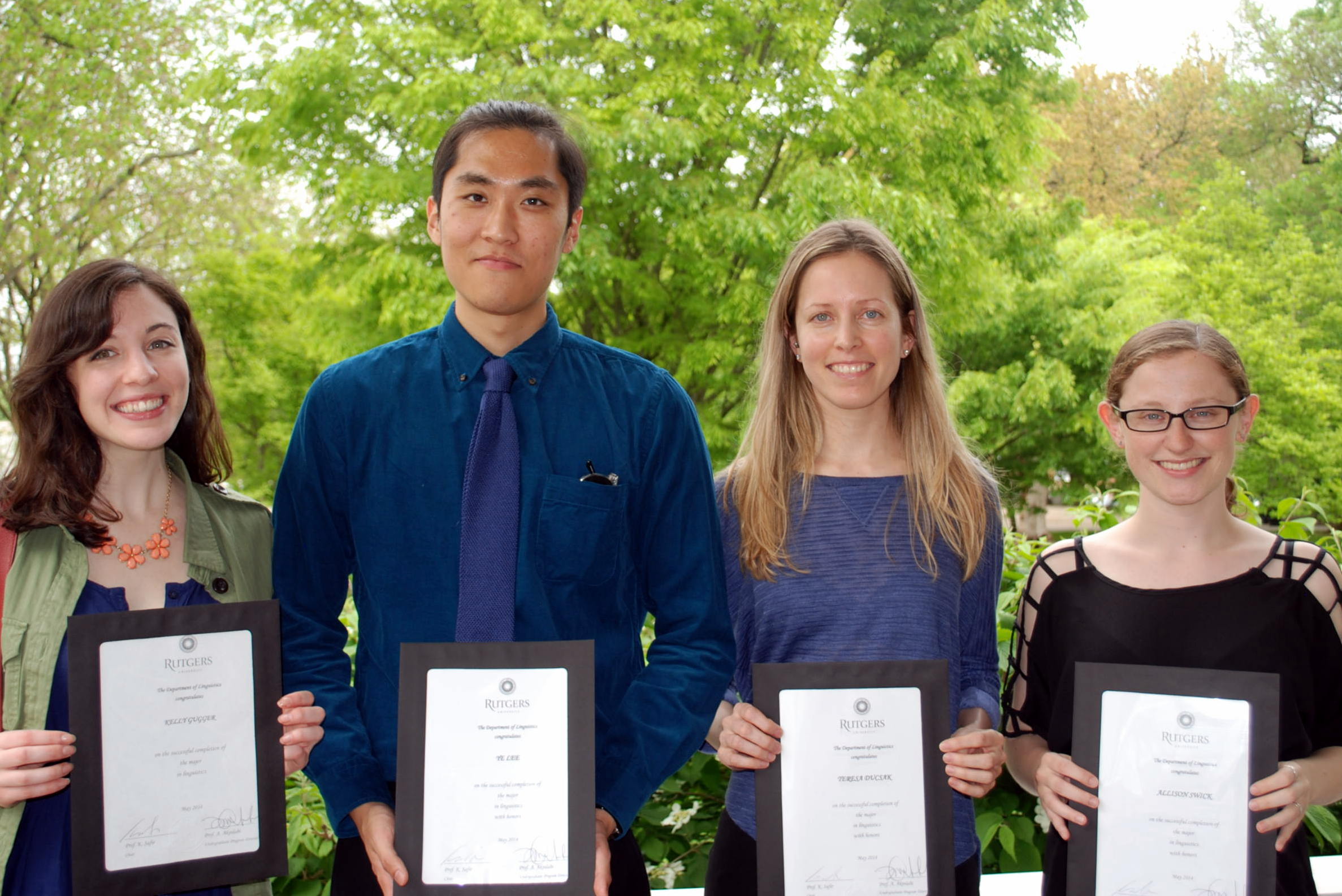
Linguistics and the Speech and Hearing Sciences
Our department offers the following options for students interested in going into the Speech and Hearing Sciences as a Career:
- The Speech and Hearing Sciences in Linguistics Major (a fully comprehensive option that include a solid Linguistics Foundation and a full suit of courses satisfying ASHA prereqs and professional development in S&H)
- The Linguistics Major or Linguistics Minor (both of which allow students to take S&H courses as electives)
- The Post-Bacc Certificate available ONLY to non-matriculating students (a fully online, great option for non-Rutgers students!)
Linguistics explores how natural languages are learned, understood, represented, and used by humans. The focus of Speech and Hearing Sciences is on how to prevent, diagnose, and treat speech, language, and communication disorders. A degree in Linguistics at Rutgers University – New Brunswick serve as an excellent foundation to the study of language and speech disorders, because the research opportunities, familiarization with core linguistic theory, and related coursework in the speech and hearing sciences help to prepare students for diverse graduate and career opportunities.
Careers in the Speech and Hearing Sciences may include clinical practice, research, or education in Speech-Language Pathology or Audiology. Speech-language pathologists (SLPs) focus on speech, language, and swallowing disorders, including disorders of voice, fluency, social communication, and cognitive communication. Audiologists focus on auditory and balance disorders. Employment settings for clinical practice include K-12 schools, hospitals, or private practice. A Masters degree for SLPs or the Doctor of Audiology (Au.D.) for audiologists is required for clinical practice. Many students pursue a Ph.D. in Speech and Hearing Sciences, allowing them to conduct important research in this area and take on future leadership roles in the field. SLPs and Audiologists with a Ph.D. conduct research or teach at colleges or universities. Some also maintain a clinical practice. Students interested in participating in independent research while at Rutgers may wish to apply for opportunities through the Aresty Research Center and McNair Program. Priority is typically given to students in their first or second year; it can be very challenging to find research opportunities as a rising senior.
For general information about Speech and Hearing Sciences, please visit any of the following online resources:
- American Speech-Language-Hearing Association (ASHA)
- Information for undergraduates
- Planning your graduate education
- Speech Pathology resources
For more information about funding for Speech and Hearing graduate programs, please visit
Department Speech and Hearing Advisor
Please contact our Speech and Hearing Advisor, Prof. Mazumdar, at speechandhearing (at) linguistics (dot) rutgers (dot) edu to learn more about the career paths in the Speech and Hearing Sciences, recommended coursework, or preparing for graduate school. The S&H Advisor also the faculty advisor to the Rutgers Speech and Hearing Club.
All academic advising for either the Speech and Hearing Sciences in Linguisics major or the Linguistics major/minor are conducted by our Undergraduate Program Director: undergrad (at) linguistics (dot) rutgers (dot) edu.
Majors and Courses for the Speech and Hearing Sciences
Students interested in applying to graduate programs in the Speech and Hearing Sciences are strongly recommended enroll in our Speech and Hearing Sciences in Linguistics Major, or to take the following courses in the Department of Linguistics as part of the Linguistics Major or Minor:
- 01:615:391 Anatomy and Physiology of the Speech Mechanism
- 01:615:392 Introduction to Communication Disorders
- 01:615:393 Audiology
- 01:615:394 Speech and Hearing Science
- 01:615:440 Language Development
- 01:615:451 Phonetics
The courses above can be used to partially fulfill the requirements for the Linguistics Major, and are required for the Speech and Hearing Sciences in Linguistics Major. It may be extremely difficult to get into these courses without being a student in either Major or the Post-Bacc certificate, given their popularity and high demand for enrollment.
Please note that because graduate programs differ in their required prerequisites, students are encouraged to contact specific graduate programs directly with any questions about these requirements and the application process.
Rutgers Speech and Hearing Club
The Rutgers Speech and Hearing Club is an active organization for students interested in pursuing careers in the speech and hearing sciences. The Club is a chapter of the National Student Speech Language Hearing Association (NSSLHA) which is recognized by the American Speech Language Hearing Association (ASHA). It has been recognized by the NSSLHA Executive Council with Bronze Chapter Honors.
The Rutgers Speech and Hearing Club meets regularly. The club organizes guest speakers representing different career paths in the Speech and Hearing Sciences, as well as other events, such as attending graduate school open houses or volunteering. The Club's faculty advisor is the Speech and Hearing advisor, who can be contacted at speechandhearing (at) linguistics (dot) rutgers (dot) edu.
Department Learning Goals and Policies
Students will be able to reason about language scientifically; demonstrate knowledge of cross-linguistic variability and universal patterns in language; evaluate a range of views on the nature, origin, and/or structure of language; and identify what someone knows when they know a language.
Majors and minors who complete the core courses in Linguistics will demonstrate technical mastery over the tools of linguistic analysis in syntax, phonology, semantics and pragmatics and apply linguistic theory in these areas. They will be able to investigate and analyze linguistic data; demonstrate strong problem-solving skills; extend their understanding of theoretical linguistics into other domains of linguistic research; and apply the techniques of linguistics to new topics. Majors will access current research in the field and be able to communicate the findings and relevance of linguistic research to both an audience in the discipline and a lay audience.
Policies
If your course syllabus has referred you to this webpage, the following policies apply to your course. Students in linguistics courses are responsible for reading these policies and abiding by them.
Specific policies may be amended or altered by a course lecturer in an individual course’s syllabus.
Rutgers Code of Student Conduct
All students are required to abide by Rutgers Student Code of Conduct.
Policy on Religiously Observant Students
It is University policy (University Regulation on Attendance, Book 2, 2.4.7B, formerly 60.14f) to excuse without penalty students who are absent from class because of religious observances, and to allow the make-up of work missed because of such absence. Examinations and special required out-of-class activities shall ordinarily not be scheduled on those days when religiously observant students refrain from participating in secular activities. Absences for reasons of religious obligation shall not be counted for purposes of reporting.
In the printed schedule of classes, students are advised that they should provide timely notification to instructors about necessary absences, and that they are responsible for making up the work or exams according to an agreed-upon schedule.
The published schedule of classes contains a reminder for students who are unable to participate in secular activities because of a religious observance to notify their instructor as early in the semester as possible. Reasonable common sense, judgment, and the pursuit of mutual goodwill should result in the positive resolution of scheduling conflicts.
Students with Disabilities
Students with documented learning disabilities are invited to visit the website for the Office Disability Services for support and accommodations.
Attendance Policy
In accordance with Rutgers University regulations, attendance is expected at all regularly scheduled meetings of this course.
Students who miss an occasional class for unverifiable illness or personal circumstances do not require written documentation or verification from the dean. In these circumstances, use the Self-Reporting Absence Application to indicate the date and reason for your absence. An email will be automatically sent to the course instructor. It is the responsibility of the student to notify instructors in a timely manner of any absences. It is up to the instructor to determine if accommodations are warranted to allow students to make up work that counts toward their semester grade.
Students missing more than an occasional class due to serious illness or serious personal circumstances should contact the Dean of Students to authenticate their absences. Faculty notified of authenticated absences should make reasonable accommodations to allow students to make up work that counts toward their semester grade.
It is the policy of the Rutgers University not to cancel classes on religious holidays. In the case of inclement weather, the President of the University may cancel classes.
Academic Integrity
All students must read and follow Rutgers’ policies on Academic Integrity.
Students must not collaborate on any assessed work (e.g. homework assignments, examinations) unless specifically directed to do so by the course instructor. Homework assignments and exams must be done independently.
‘Collaboration’ includes
- Working together to determine an answer to an assignment/exam answer
- Discussing and comparing assignment/exam answers before the due date
- Reviewing another student’s assignment/exam answers before the due date
Collaboration is a violation of the Academic Integrity policy. All instances of plagiarism will be reported to the Office of Student Conduct.
Concerns
Any concern should first be directed to the Course Instructor/Lecturer. (The concern should be shared in a timely manner, and that individual should be given an opportunity to address the concern.) If the concern is still not resolved or questions remain, the concern will be referred to the Undergraduate Program Director.
E-mail and Contact Information Policy
As a student in Linguistics, you will receive regular communications from your instructors and the Undergraduate Program Director. It is your responsibility to ensure that you:
- Have a functional Rutgers email address, and communicate using this email address (in lieu of a personal email account).
- Check your email on a regular bases (multiple times a week).
- Have your Canvas notifications set up so that you receive course announcements.
- Respond to direct emails to you from your instructors or the UPD in a timely manner (within 24-48 hours maximum).
For more information on Undergraduate Education, please visit the Office of Undergraduate Education.