Department of Linguistics
Undergraduate Speech and Hearing Sciences in Linguistics MAJOR
Speech and Hearing Sciences in Linguistics Major Flyer
To declare a major in Linguistics, please go to mymajor.sas.rutgers.edu.
To be accepted as a Speech and Hearing Sciences in Linguistics Major you must pass 615:201 Introduction to Linguistic Theory with a grade of C or better.
A Major in Speech and Hearing Sciences in Linguistics consists of 22 courses total (21 courses of 3 credits each and 1 course of 1.5 credit) for a total of 64.5 credits.
This Major is considered a credit-intensive major. As a result, the requirement for a minor is waived for students completing this major. Students in credit intensive majors may still choose to complete a minor, even though they are not required to do so, or double major. Popular combinations include a Cognitive Science major or a Developmental Psychology minor.
A grade of C or better must be earned in all course work that is to be applied to the major.
For information about Speech and Hearing Sciences in Linguistics at Rutgers, please contact our S&H Advisor: speechandhearing (at) linguistics (dot) rutgers (dot) edu.
All academic advising either the Speech and Hearing Sciences in Linguisics or the Linguistics major/minor are conducted by our Undergraduate Program Director: undergrad (at) linguistics (dot) rutgers (dot) edu.
The distribution of these courses falls into seven main categories, as specified below. (There are three components in addition to the four required for the Linguistics Major.)
Majors may also participate in the Departmental Honors Program and complete a thesis in their senior year. See requirements on the Linguistics Major page.
Requirement R1: Introduction to Linguistics (A) - (1 course, 3 credits)
OFFERING: At least 5 sections every semester, including 1 Honors section
- 201 Introduction to Linguistic Theory (1 course, 3 credits)
This course is required. It is a prerequisite for all courses in (B) and many (but not all) in (C) and (D): it must be taken before them.
Requirement R2: Theoretical Linguistic Subfields (B) - (4 courses, 3 credits each, 12 credits total)
OFFERING: At least 1 section of each B course every semester, with 2 sections of at least 2 B courses each semester
These four courses
- 305 Syntax (taught every semester)
- 315 Phonology (taught every semester)
- 325 Semantics (taught every semester)
- 350 Pragmatics (taught every semester)
Requirement R3: Linguistics Electives (C and D) - (6 courses, 3 credits each, 18 credits total)
OFFERING: At least 2-3 C and 1 D course within Linguistics every semester
R3.1: These two courses (3 credits each, 6 credits total)
- 440 Language Development (taught every spring)
- 451 Phonetics (taught at least one semester a year, typically fall)
R3.2: Four Linguistics (C) and (D) courses (including at least one 1 (C) Course and at most three (D) Courses)
Note: You can fulfill R3.2 with 4 C and no D, 3 C and 1 D, 2 C and 2 D, or 1 C and 3 D. This is different from the Linguistics Major, because of the requirement in R3.1.
(C) Must take at least one, up to four
- 330 Historical linguistics (taught every 2-3 years) (cross-listed with Classics department)
- 381 Sociolinguistics (online) (taught every year)
- 411 Morphology (taught every year)
- 421 Language Typology (taught on occasion)
- 425 Romance Linguistics (taught on occasion)
- 431 Investigations into an Unfamiliar Language (taught every 2 years)
- 441 Linguistics and Cognitive Science (taught every fall)
- 455 Computational Linguistics (taught every year, typically spring)
- 465 Introduction to Prosody (taught on occasion)
- 461 Linguistics of Signed Languages (taught every year/every other year, typically spring)
- 471 Selected Topics in Linguistics (taught every 2-3 years, topics vary)
- 481 Language and Law (online) (taught every other year, typically fall)
- 493/4 Independent Study (by SPN only, reserved for students with pre-arranged independent research with faculty)
- 495/6 Senior Honors Thesis (by SPN only, reserved for students with pre-arranged faculty advisors,
one applies to (C), second applies to (E))
(D) May take at most 3, with at most 2 D electives at the 200-level.
Note: The list of D courses for this Major includes most Courses from the list of Approved Outside Courses (see below).
Please see important restrictions in Degree Navigator on D electives for this major.
The D electives do NOT include the 39x courses, which required in R5 (below).
- 215 Language of Advertising (online) (taught every other year, typically spring)
- 445 Language and Cognition (taught every other year, cross-listed with Cognitive Science)
- 491 Practicum in Linguistics (reserved for students doing research with faculty as research assistants, SPN from UPD required to register)
See the Approved Outside Courses.
Requirement R4: Linguistics Capstone (E) - (1 course, 3 credits)
OFFERING: 1 section every semester
Choose one option.
Note: For the vast majority of the students in the Speech and Hearing Sciences in Linguistics Major, the Capstone will be 615:497 (the Advanced Seminar) NOT the Honors thesis.
- 495/496 Senior Honors Thesis (first semester applies to (C), second applies to (E); MUST have faculty advisor permission and submit a proposal by the end of May of your Junior year, SPN from UPD required to register)
- 497 Advanced Undergraduate Seminar (taught every semester, SPN from UPD required to register)
Requirement R5: Core ASHA-aligned Speech and Hearing Science Courses - (4 courses, 3 credits each, 12 credits total)
OFFERING: 2 courses each semester, covering all four courses in an academic year
Note: These courses count as D electives in R3 for the Linguistics Major, but do not count as D electives for the Speech and Hearing Sciences in Linguistics Major, since all four are required to satisfy R5.
- 391 Anatomy and Physiology of the Speech Mechanism (online) (taught every spring, best for students pursuing a path in Speech and Hearing Sciences)
- 392 Introduction to Communication Disorders (online) (taught every fall, best for students pursuing a path in Speech and Hearing Sciences )
- 393 Audiology (online) (taught every fall) (best for students pursuing a path in Speech and Hearing Sciences)
- 394 Speech and Hearing Science (online) (taught every spring, best for students pursuing a path in Speech and Hearing Sciences)
Requirement R6: Speech and Hearing Electives - (4 courses, 3 credits each, 12 credits total)
OFFERING: At least 2-3 courses for each category each semester offered by other departments
1 course from each of the following four sets of courses (based on ASHA requirements)
Notes:
No more than 2 of these courses may be at the 100 Level.
No credits may be used from Advanced Placement (AP) Courses.
No more than 1 course may be used from other Non-New Brunswick Courses (i.e., Transfer courses, and courses taken at Rutgers Camden or Newark).
- Statistics Electives
- Biological Sciences Electives
- Physical Sciences Electives
- Social/Behavioral Sciences Electives
Requirement R7: Speech and Hearing Capstone - (2 courses, 3 credits and 1.5 credits, 4.5 credits total)
OFFERING: 290 of every fall, 498 every semester
- 290 Career Explorations in Speech and Hearing Sciences in Linguistics (online) (new in AY25-26, taught every fall)
- 498 Research Methods and Professionalism in Speech and Hearing Sciences (online) (new in AY25-26, taught every semester)
Requests for evaluation of transfer and study abroad courses should be sent to the Undergraduate Program Director at undergrad (at) linguistics (dot) rutgers (dot) edu.
Departmental Honors Designation
- All students graduating with at least a 3.8 GPA in the Speech and Hearing Sciences in Linguistics Major are designated as graduating with Departmental Honors.

- Kristen Syrett
- Department Chair; Professor; Co-Director, Center for Cognitive Science
- Personal Website
- she/her
- Email:
This email address is being protected from spambots. You need JavaScript enabled to view it. - Leadership Email:
This email address is being protected from spambots. You need JavaScript enabled to view it. - Interests: Language acquisition, experimental semantics and pragmatics, psycholinguistics, syntax/semantics interface
- Office: Room 304
- Office Hours: by appointment only
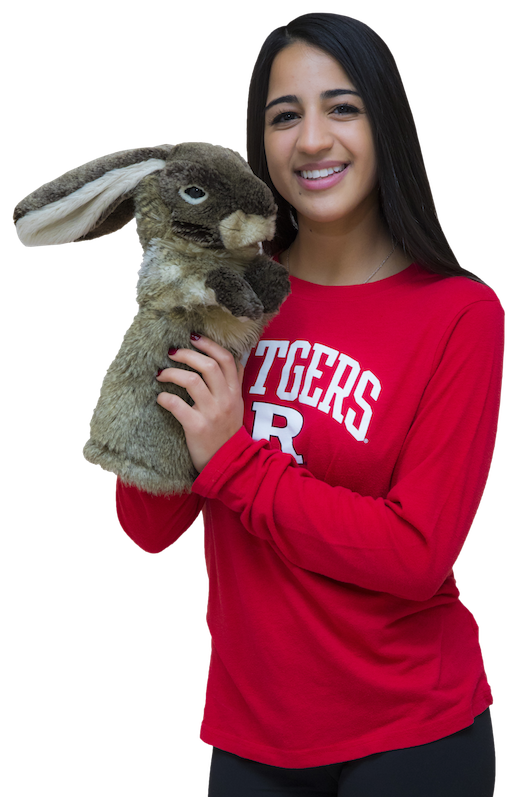
Aida Bahrami was in high school when she discovered the field that has become her calling at Rutgers.
In an honors sociology class at Hunterdon Central Regional High School, Bahrami learned about the Deaf community, and the role that speech-language pathologists play in supporting and treating people with hearing loss.
“Their work is so impactful,” Bahrami said. “They play an incredibly important role in people’s lives.”
Now a School of Arts and Sciences senior, and a member of the Class of 2018, Bahrami is poised to take a major step on the path that began with that high school class: Next fall she will enter a master’s degree program in communication sciences and disorders at Teachers College, Columbia University, with the ultimate goal of becoming a speech-language pathologist.
“I feel that everything I’ve done at Rutgers has prepared me for this moment,” she said.
Indeed, over the last four years, Bahrami has created a distinctive undergraduate experience, one that embraces a broad, liberal arts education while giving her room to grow in her passion for speech-language pathology. She majored in linguistics, minored in cognitive science, and earned a certificate in speech and hearing sciences.
“After high school I wasn’t sure I wanted to go to school specifically for speech-language pathology,” she said. “At Rutgers, I took some linguistics courses and fell in love with it. I wasn’t studying the mechanisms of the mouth, but I was studying the roots, history, and processes of language, which was fascinating and incredibly helpful.”
She also acquired a wealth of experience outside of the classroom, doing research, working at a local medical practice, and shadowing speech pathologists, including a team that treated kids with autism spectrum disorders at the Douglass Developmental Disabilities Center.
“I can vividly remember the first time I walked in and saw how they were being enabled,” she said. “I knew this was where I wanted to be.”
Meanwhile, at the Pediatric and Adult Rehabilitation Center in Somerset, where she worked as an office coordinator and therapy assistant, Bahrami was able to observe patients and make connections between their symptoms and the theoretical material she was learning in her classes, such as phonology, the study of the patterns of sounds in languages.
“I was quick to notice that the difficulty a patient had in pronouncing sounds was in fact due to phonological processes,” she wrote in a reflection on her work. “My strong understanding of phonology allowed me to distinguish the processes that the child was exhibiting.”
She also served as a research assistant and peer instructor at the Aresty Research Center, and was a member of linguistics professor Kristen Syrett’s research team in the Laboratory for Developmental Language Studies.
Syrett, whose research explores complex questions about language acquisition, praised Bahrami for her desire to use her training and knowledge to make a positive change in people’s lives.
“She is one of the most cheerful, hard-working, professional, devoted students and research assistants I have encountered in my time at Rutgers,” Syrett said. “Her love of language and child development, careful training, and interest in intervention and education will no doubt benefit any population she serves.”
Bahrami says one of the appealing aspects about speech-language pathology is the broad range of populations it serves, including the Deaf, the developmentally disabled, and those with autism. There is also an active research community.
While she hasn’t decided on a specialty, she feels fortunate to have found her calling.
“I want to empower people to have a voice,” she said.
-

Marimar Suarez
2020 -
Krysta Duquette
2017 -

Victoria Gonzalez
2020
Please refresh this page to see more student and alumni interviews!
Majoring in Linguistics can take you where you want to go!
The study of language, like other fields of empirical research, yields dividends beyond its own domain. Modern work in linguistics has had a profound impact on many fields where language is central: psychology, cognitive science, computer science, philosophy, the study of individual languages, literary theory, and anthropology. Students of linguistics can focus closely on language and its empirical phenomena through the study of syntax, semantics, or phonology, and they can also explore the many cross-disciplinary connections between linguistics and other fields.
Arts and Sciences in Action: Linguistics
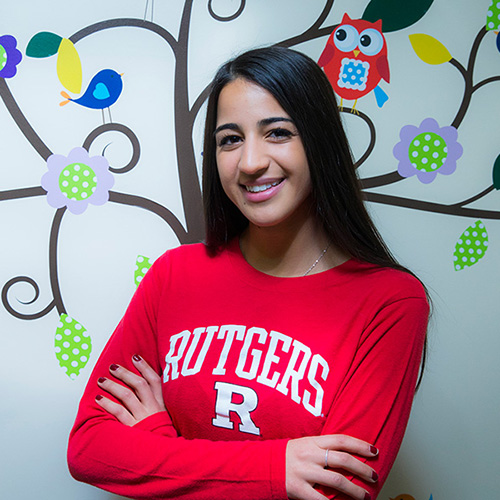
"I feel everything I’ve done at Rutgers has prepared me for this moment. I want to empower people to have a voice"
Aida Bahrami
Class of 2018
Study Linguistics
Explore differences and similarities among the world's languages
Impress your family and friends with your linguistic knowledge
Become a better conversationalist
Come to appreciate linguistics as a science
Learn about how we acquire and process language
Enrich your training in the speech and hearing sciences
Get an edge when applying to graduate schools
The Department of Linguistics is part of the School of Arts and Sciences
As a Linguistics major in the School of Arts and Sciences, you’ll have full access to a liberal arts education that spans 47 programs for undergraduates. You will acquire both the specialized knowledge of the field you choose to study in depth, and broad knowledge of the world from the renowned scholar-teachers at Rutgers. You’ll graduate ready to meet contemporary challenges in your workplace, in your hometown, and in the global community.
Visit Rutgers School of Arts and Sciences Website